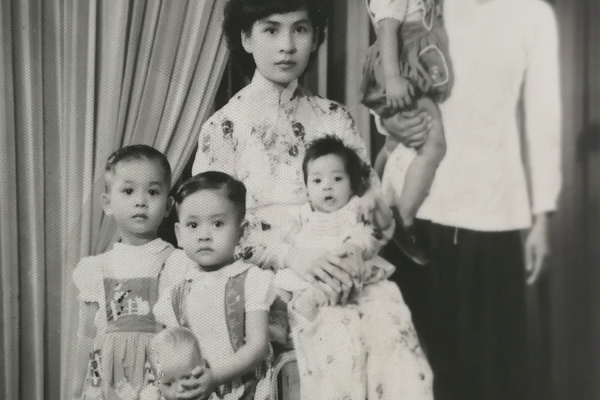
Landscape in Oblivion, Opera in Two Legends and Three Stories (2022—2024), 2022
Landscape in Oblivion is imagined as an oratorio where the theatrical action is mixed with music. It deals with the silence and absence of a memory that is both familial and cultural. The poem is meant to be a quest, whose stanzas will be fed by visions of today's Việt Nam, while the past – sung – will be reconstructed from recovered memories. What connects us to a land? What is our relationship with our roots? What ties us to one country more than another?
Olivier Dhénin Hữu's story is linked to exile, his ancestors are from this colony which was called "Indochina"; his mother left Saigon a few years after the Geneva agreements in 1959, at the beginning of the American War. Uprooted, she had to break all ties with her native country against her will. This extreme East has never ceased to haunt Olivier Dhénin Hữu's thinking and to fuel a questioning of the notion of elsewhere and origin. The artist wants to ask questions about this invisibilized history, this memory of exile and displacement.
Born in Kinshasa in a country that used to be called Zaire, Nigji Sanges' only memories are of "landscapes", perfumes, faces that have become mirages, snatches of language and popular songs that she knew as a child and that she has, no doubt unconsciously, wanted to capture for fear of forgetting them. Strangely enough, music, by its nature and evocative power, has allowed her to maintain a form of living link with the here and now elsewhere, and it is perhaps through these circumstances that it has remained fundamental and primordial in her life ever since.
Through the prism of one family story, millions of others are echoed. The book depicts a universal experience in the background: an exodus that resonates with so many others in multiple realities - regardless of time, political, familial or cultural reasons. It also deals with voluntary or involuntary amnesia, where a transmission has been omitted, sometimes as a result of a past that is too painful and that one prefers to extinguish rather than revive by telling and speaking. The gaping but hidden wound is anaesthetized by silence and the passage of time.
CAST AND INSTRUMENTATION
(Casting in progress)
Director and set design: Olivier Dhénin Hửu
Lighting: Anne Terrasse
Dramaturgy: Émilien Ruf
Costume: Hélène Vergnes
Stage manager: Thibaut Lunet
Mezzo-soprano: Anne-Marine Suire
Baritone: Aimery Lefevre
Vietnamese songs and percussion
Orchestra: TBD
Electronic: TBD
DESCRIPTION
Duration: 2h30
World premiere: Hô Chi Minh City – Vietnam
(In residence in Hô Chi Minh-City as part of the Villa Saïgon programme of the Institut Français 2021/22)
COMMISSION AND PRODUCTION
Institut français, Compagnie Winterreise
Publishing House: TBD
PERFORMANCES
TBD
Landscape in Oblivion is imagined as an oratorio where the theatrical action is mixed with music. It deals with the silence and absence of a memory that is both familial and cultural. The poem is meant to be a quest, whose stanzas will be fed by visions of today's Việt Nam, while the past – sung – will be reconstructed from recovered memories. What connects us to a land? What is our relationship with our roots? What ties us to one country more than another?
Olivier Dhénin Hữu's story is linked to exile, his ancestors are from this colony which was called "Indochina"; his mother left Saigon a few years after the Geneva agreements in 1959, at the beginning of the American War. Uprooted, she had to break all ties with her native country against her will. This extreme East has never ceased to haunt Olivier Dhénin Hữu's thinking and to fuel a questioning of the notion of elsewhere and origin. The artist wants to ask questions about this invisibilized history, this memory of exile and displacement.
Born in Kinshasa in a country that used to be called Zaire, Nigji Sanges' only memories are of "landscapes", perfumes, faces that have become mirages, snatches of language and popular songs that she knew as a child and that she has, no doubt unconsciously, wanted to capture for fear of forgetting them. Strangely enough, music, by its nature and evocative power, has allowed her to maintain a form of living link with the here and now elsewhere, and it is perhaps through these circumstances that it has remained fundamental and primordial in her life ever since.
Through the prism of one family story, millions of others are echoed. The book depicts a universal experience in the background: an exodus that resonates with so many others in multiple realities - regardless of time, political, familial or cultural reasons. It also deals with voluntary or involuntary amnesia, where a transmission has been omitted, sometimes as a result of a past that is too painful and that one prefers to extinguish rather than revive by telling and speaking. The gaping but hidden wound is anaesthetized by silence and the passage of time.
CAST AND INSTRUMENTATION
(Casting in progress)
Director and set design: Olivier Dhénin Hửu
Lighting: Anne Terrasse
Dramaturgy: Émilien Ruf
Costume: Hélène Vergnes
Stage manager: Thibaut Lunet
Mezzo-soprano: Anne-Marine Suire
Baritone: Aimery Lefevre
Vietnamese songs and percussion
Orchestra: TBD
Electronic: TBD
DESCRIPTION
Duration: 2h30
World premiere: Hô Chi Minh City – Vietnam
(In residence in Hô Chi Minh-City as part of the Villa Saïgon programme of the Institut Français 2021/22)
COMMISSION AND PRODUCTION
Institut français, Compagnie Winterreise
Publishing House: TBD
PERFORMANCES
TBD